The European Commission has published a new proposal aimed at aligning packaging waste sorting labels across the EU, a move designed to support the upcoming Packaging and Packaging Waste Regulation (PPWR). Developed by the Commission’s Joint Research Centre (JRC), the initiative seeks to simplify recycling for consumers, improve sorting outcomes and reduce market fragmentation caused by different national labelling systems.
TABLE OF CONTENTS
Supporting the Green Deal and Circular Economy Goals
The proposal was prepared by the JRC on behalf of the Directorate-General for Environment and sits within the wider objectives of the European Green Deal and the Circular Economy Action Plan 2.0. Its main purpose is to create a common framework for waste sorting labels that can be applied consistently across all Member States.
To shape the recommendations, the JRC consulted more than 250 industry and policy stakeholders, alongside around 25,000 EU citizens. Input was also gathered through workshops, behavioral studies, online surveys and background research carried out by the JRC itself.
Moving Away from Fragmented Labelling Systems
At the heart of the proposal is the challenge posed by today’s patchwork of national labelling schemes. According to the JRC, inconsistent symbols and instructions undermine recycling performance and create unnecessary barriers within the internal market.
To address this, the proposal recommends a set of shared, easy-to-understand pictograms that can be used on packaging across the EU. Research showed that consumers responded particularly well when these symbols were matched with bins using the same color system, helping them link packaging to the correct disposal route more quickly.
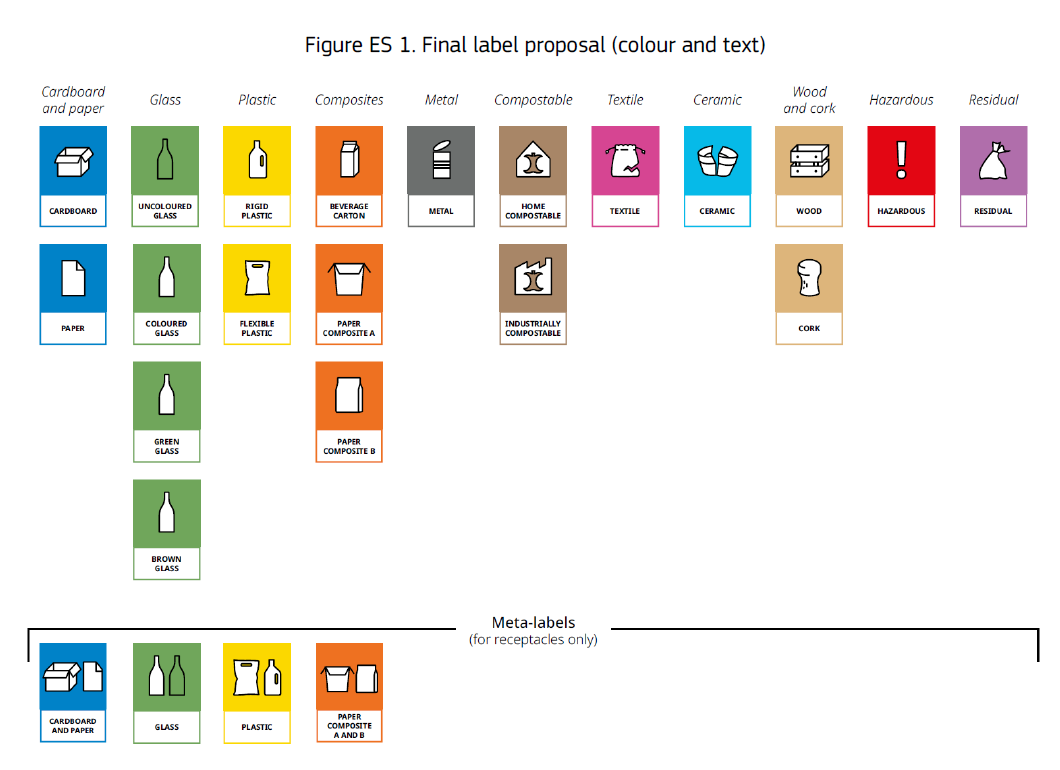
Final label proposal (colour and text). Source: Bruns et al., 2026, JRC Technical Proposal on EU Harmonised Waste Sorting Labels, JRC Publications Repository, Figure ES 1.
Accessibility and the Role of Color
The proposal also highlights the limits of color-only solutions. Behavioral testing found that nearly half of participants had difficulty interpreting black-and-white labels, while people with color vision deficiencies or certain cognitive impairments showed a slight preference for non-colored designs.
As a result, the JRC stresses that color coding should support, not replace, clear pictograms and written instructions. This way, accessibility considerations are presented as a core requirement rather than optional.
Digital Tools to Add Flexibility
To overcome space constraints and language barriers, the proposal points towards digital options such as QR codes. These could provide extended sorting guidance, offer instructions in multiple languages, or adapt information to national or regional rules. Additionally, digital tools are also presented as a way to better accommodate users with disabilities.
Clear Distinction for Compostable Packaging
The JRC also calls for clearer on-pack guidance for compostable materials. Home-compostable and industrially compostable packaging should be clearly differentiated using dedicated pictograms and explanatory text. For industrially compostable items, the proposal suggests adding a visible warning such as “DO NOT THROW IN NATURE,” with an optional abbreviated label placed next to the main sorting symbol.
Handling Multi-Material Packaging
Recognizing the complexity of modern packaging, the proposal allows for multiple labels on a single pack when different components require different disposal routes. Waste bins may also indicate that more than one material can be placed inside, sometimes through combined or so-called meta-labels.
However, the JRC warns that such combined symbols can be confusing if consumers do not understand how they relate to individual on-pack labels. For the aforementioned reason, meta-labels should be used sparingly, supported by clear guidance and never printed directly on packaging.
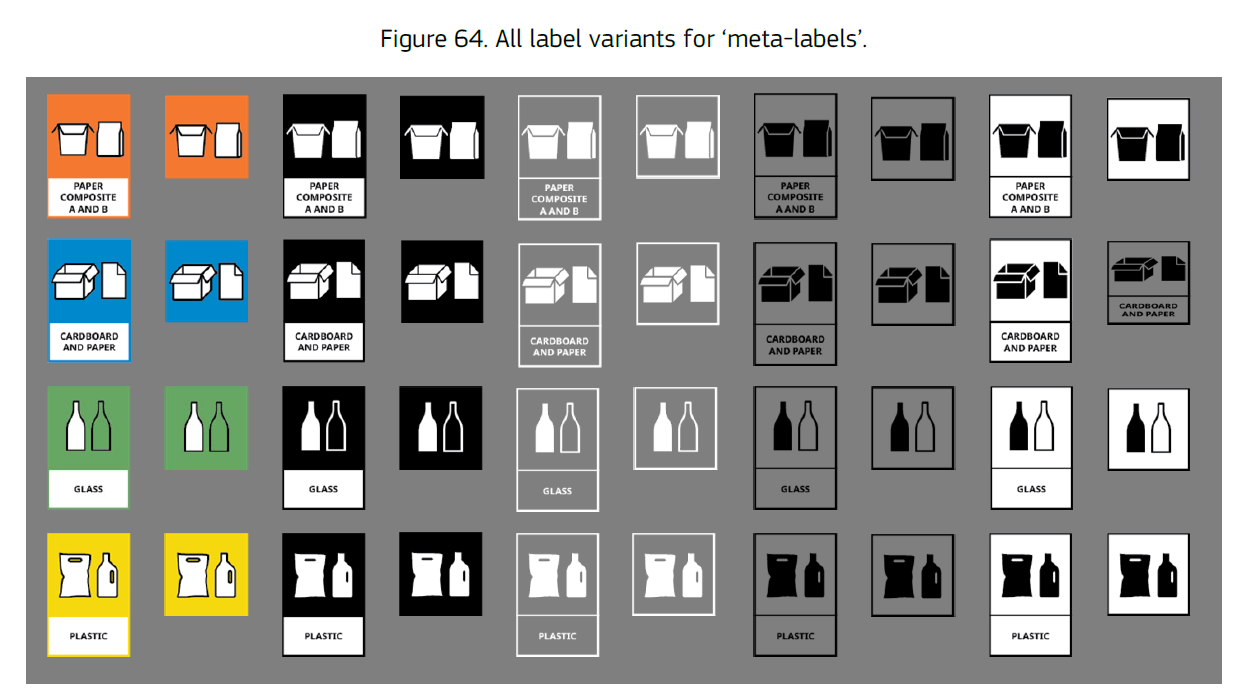
All label variants for ‘meta labels’. Source: Bruns et al., 2026, JRC Technical Proposal on EU Harmonised Waste Sorting Labels, JRC Publications Repository, Figure 64.
Residual Waste and Innovation
The proposal also introduces the idea of clearly marking materials that fall into residual waste streams under local rules. This category is described as a temporary solution for new or innovative packaging formats where the optimal recycling route has not yet been established.
Regulatory and Practical Challenges Ahead
Moreover, several open issues are acknowledged. These include limited space on packaging, the difficulty of providing clear instructions for composite materials and the need to respect existing national practices when harmonizing colors and wording across the EU.
The level of detail on labels is another concern. While more detailed instructions can help, too much information risks overwhelming consumers. The proposal also notes that, in some cases, advanced sorting technologies may perform better than consumer-led separation, though this is not consistent across all regions.
The interaction with national deposit return schemes is also flagged as an area requiring careful coordination to avoid conflicting messages.
Cost Implications and Evidence Gaps
Introducing new labelling requirements will bring costs related to redesign, printing and system updates. The JRC notes that small and medium-sized enterprises are likely to feel this impact the most, and so to ease the transition, it recommends phased implementation, following clear guidance and using targeted support.
Conclusion
Overall, the JRC recommends a centrally driven approach, with harmonized labelling introduced through an EU implementing act. The ongoing involvement of stakeholders, along with flexibility to adapt the system overtime and sustained communication and education efforts, are all seen as essential in making harmonized packaging labels work in practice across the EU.