On April 10, 2026, Portugal officially launched its national Deposit Return Scheme (DRS), branded as Volta. The implementation follows an extensive preparation phase that began in April 2025, as previously discussed here. This move is a direct response to the country’s historical struggle to meet European Union recycling benchmarks. With a plastic packaging recycling rate that sat at approximately 40 % in 2023, well below the targets mandated by the Single Use Plastics Directive (SUPD), the Volta system represents a high-stakes technological and behavioral intervention designed to modernize the Portuguese circular economy.
TABLE OF CONTENTS
By introducing a financial incentive for the return of single-use beverage containers, Portugal aims to rapidly ascend from its 2022 recycling lows to a 90 % collection rate by 2029. This implementation is managed by SDR Portugal and powered by Sensoneo’s specialized digital infrastructure.
Bridging the Compliance Gap: SUPD and PPWR Targets
The primary driver behind the April 10 launch is the pressure to meet increasingly stringent EU regulations. Portugal failed to meet the 77 % separate collection rate for plastic bottles required by 2025, necessitating a radical shift in how waste is managed at the consumer level.
The Volta system is designed to help Portugal reach the following milestones:
- SUPD 2029 Target: A 90 % separate collection rate for plastic beverage bottles.
- PPWR 2030 Goals: Reaching a 55 % recycling rate for all plastic packaging and preparing for 2040 mandates, which require 65 % recycled content in single-use beverage bottles.
By capturing high-quality, food-grade PET and metals through a dedicated stream, the DRS ensures that materials are not contaminated by other household waste, making them suitable for the “bottle-to-bottle” recycling required by these regulations.
Technical Mechanics: The €0.10 Incentive and “Volta” Logo
The system operates on a straightforward deposit-and-refund model. Consumers now pay a €0.10 deposit on eligible containers, which is refunded upon the return of the empty packaging. For a container to be eligible for a refund, it must bear the official Volta logo and fall under the following categories:
- Material Types: PET plastic bottles, aluminum cans and steel cans.
- Capacity: Containers must be single-use and have a capacity of up to 3 liters.
Upon returning the container, consumers receive a coupon that can be exchanged for cash or used as credit for groceries at participating supermarkets.
Scaling Infrastructure: From 500 to 2,500 Machines
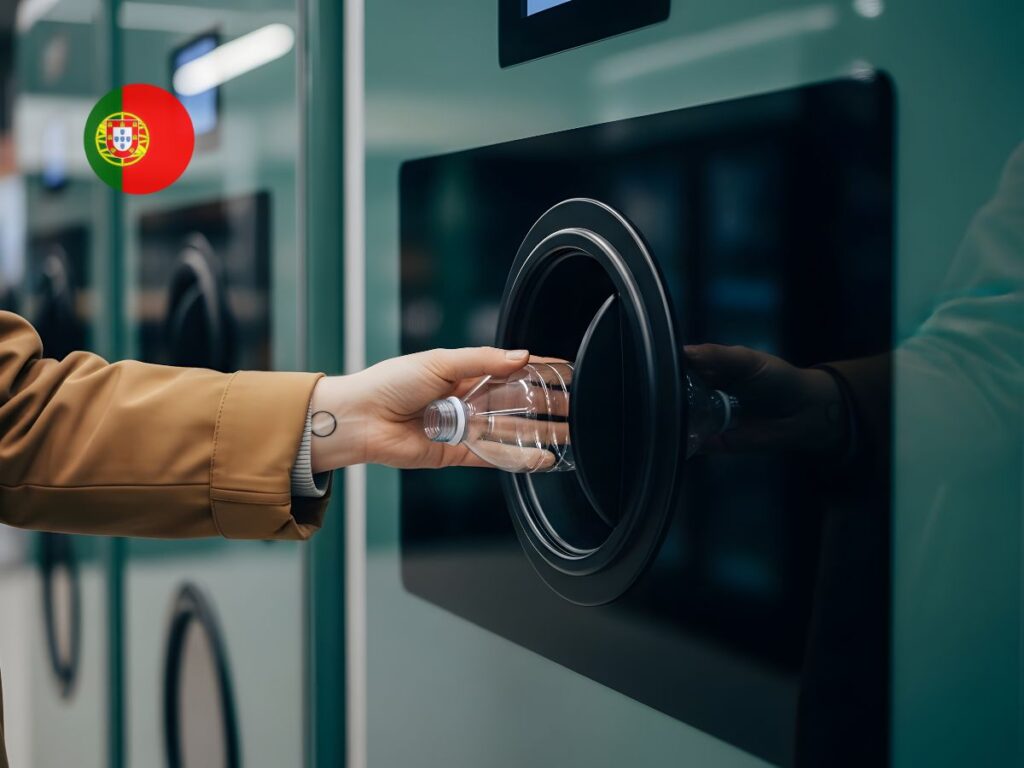
At the time of launch, the infrastructure consisted of 500 reverse vending machines (RVMs) and 48 manual return points. However, this is only the initial phase of a massive national rollout. To achieve the 2029 targets, the government and SDR Portugal will scale up to :
- 2,500 reverse vending machines nationwide.
- 8,000 return points to ensure accessibility for independent retailers and smaller municipalities.
The technology behind these RVMs is provided by global leaders like Tomra, utilizing Sensoneo’s digital platform to track barcodes (EANs) in real-time. This ensures that only containers sold within the Portuguese market (and for which a deposit was paid) are accepted into the system, preventing cross-border fraud.
The Iberian Context: Lessons for the Southern Market
Portugal’s launch is being closely monitored by its neighbor, Spain, which is preparing its own DRS. Portugal’s “pioneer” status in Southern Europe provides a specific test case for how these systems function in warmer climates and tourism-heavy economies.
- Unlike the successful DRS models in colder countries like Sweden, Portugal must account for significant seasonal peaks in beverage consumption driven by summer tourism.
- The system is designed to work across a diverse retail landscape, from massive hypermarkets to small, independent shops, requiring an adaptable logistical network that can handle variable storage needs.
Conclusion
The launch of the Volta DRS on April 10, 2026, marks a critical turning point for Portugal. By moving away from a failing selective collection model and toward a digital, incentive-based system, the country is finally aligning its infrastructure with the EU’s circular economy goals. While the path to 90 % collection is steep, the integration of 3,000 initial collection points and a clear €0.10 incentive provides the necessary framework to transform packaging from waste into a valuable industrial resource. For the packaging industry, Portugal now serves as the primary regional model for how to implement a modern DRS in a complex, southern European market.