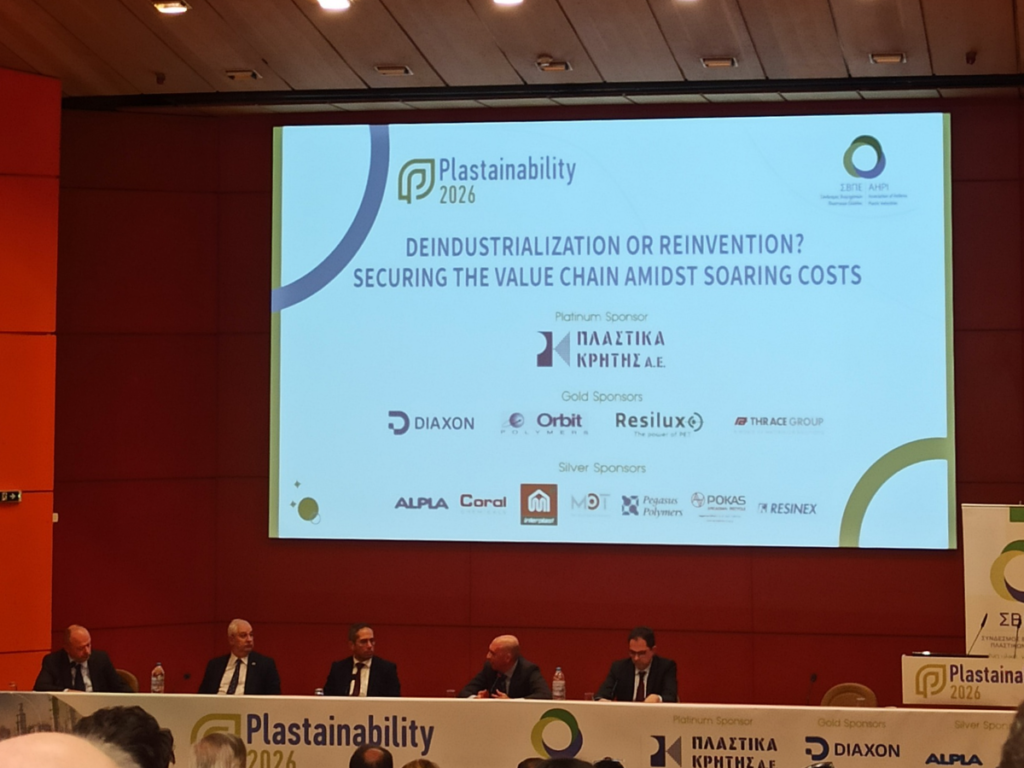
Athens, October 19, 2026 – The European plastics sector is navigating one of its most complex periods: tightening regulation, rising energy costs and a circular economy transition that demands investment at scale. Plastainability 2026, the AHPI’s fourth annual conference held October 19 at NCSR Demokritos in Athens, brought together policymakers, converters and researchers to chart a path forward.
TABLE OF CONTENTS
Circularity as an Economic Imperative
Opening the conference, AHPI President Panagiotis Gerontopoulos stressed that packaging converters and raw material producers are committed to long-term environmental protection, but that European targets must be anchored in practical realities. He pointed to continued delays in Greece’s national Deposit Return System as evidence that coordinated public-private dialogue remains urgent.
In her keynote, EU Commissioner for Environment, Water Resilience, and a Competitive Circular Economy Jessika Roswall outlined the goals of the upcoming Circular Economy Act: stimulating demand for recycled polymers, establishing an EU-wide single market for secondary raw materials, leveling the playing field against non-EU imports and simplifying compliance for businesses.
Europe’s 48,000 Converters Under Pressure
The new EuPC Director General Erich Cuaz outlined the scale of the sector: 48,000 companies, 1.3 million workers and over 270 billion euros in turnover, accounting for 90 % of all businesses and jobs across the EU plastics value chain.
Cuaz presented data showing that the packaging net export margins narrowed from 12 % to 9 %. On circularity, the numbers were equally sobering: the EU circularity rate moved from 10.7 % in 2010 to just 12.2 % in 2024, an increase of only 1.5 % over 14 years, far short of the 24 % target for 2030.
To reverse these trends, the EuPC called for five measures:
- Regulatory certainty under the PPWR
- Mandatory recycled content auditing for non-EU imports
- End-to-end trade flow monitoring covering downstream converters rather than stopping at raw resin
- Harmonized EU End-of-Waste criteria so recycled pellets move freely across EU borders under identical standards
- Industrial energy cost competitiveness with overseas competitors
Greek Resilience Amid Continental Decline
During Panel 1, the General Director of Industry from the Ministry of Development contrasted European and Greek performance. Europe’s share of global plastics production fell from 22 % in 2006 to 12 % in 2024. By contrast, ELSTAT data showed Greek sales of rubber and plastic products holding steady at 2.14 billion euros in 2024.
To sustain this base, the Ministry highlighted a new Special Spatial Framework for Industry and Logistics, a revised Development Law with a mandatory 90-day evaluation deadline for investment projects and enhanced customs and market surveillance against non-compliant imports.
MACPAC AE CEO Stefanos Papazoglou reinforced this picture from the converter side, noting that Greek producers face growing pressure from third-country suppliers operating under lower energy costs and less restrictive standards. Despite continuous crisis management since 2010, from the sovereign debt crisis through COVID-19 and successive energy shocks, the sector continues to export and invest.
Looking Ahead
The conference’s recurring conclusion was clear: circularity and competitiveness must advance together. For Europe’s packaging value chain, that means predictable regulation, harmonized standards, enforceable import controls and material evaluation grounded in evidence. Without these foundations, speakers warned, the circular transition risks accelerating deindustrialization rather than preventing it. As EU targets tighten and global trade dynamics shift, the need for coordinated action between industry, national governments and European institutions is becoming harder to defer.
Pack-Lab attended Plastainability 2026, staying close to the policy and industry shifts that define the European packaging landscape. Now in its fourth consecutive year, the AHPI conference has established itself as a central forum for dialogue between converters, regulators and researchers, and a reference point for the strategic direction of Europe’s plastics and packaging sector.