The PPWR became applicable on 12 August 2026. On the same day, the European Commission was required to have adopted the implementing act that would define what the new harmonized packaging labels look like, what information they carry and how they are formatted. It did not. The implementing act under Article 12 remains unpublished and it is not the only piece of secondary legislation running behind schedule.
TABLE OF CONTENTS
What Was Due and What Happened
The Joint Research Center (JRC) published a technical proposal for the label system in January 2026 and a targeted stakeholder consultation followed. However, the complexity of designing a pictogram system that works across 27 Member States with different sorting infrastructures, languages and waste collection systems proved more time-consuming than anticipated.
According to EUROPEN, the labelling implementing acts are now expected in Q4 2026. Industry sources suggest the additional time is needed for further stakeholder engagement to ensure the act is clear, comprehensive and workable across all Member States. The Commission has not published a revised timeline.
This is not the only implementing act that has slipped. The implementing act on the Register of Producers under Article 44(14), originally due by 12 February 2026, has also been delayed. Of approximately 30 delegated and implementing acts expected under the PPWR over the coming years, only one – the delegated decision exempting pallet stretch films and strapping from reuse requirements – had been adopted by mid-August 2026.
What the Labels Will Cover
The implementing act under Article 12 is expected to establish a harmonized, pictogram-based labelling system covering three distinct elements:
- A material composition label for all packaging, designed to help consumers identify what the packaging is made from and sort it into the correct waste stream. This label will use standardized pictograms rather than text, removing language barriers.
- A set of corresponding labels for waste receptacles, the bins and containers into which consumers deposit their packaging waste. These labels must visually match the packaging labels so that the connection between packaging and bin is immediately clear.
- Applying from February 2029, a QR code or digital data carrier for reusable packaging. This will link to information about the reuse system, return points and the number of use cycles the packaging is designed for.
Until the implementing act is adopted, none of these label formats, pictogram designs or technical specifications exist in finalized form.
Impact on the Labelling Timeline
The delay does not remove the labelling obligation but it does shift the effective compliance date. Article 12 states that the labelling requirements apply from 12 August 2028 or 24 months after the relevant implementing act enters into force, whichever is later. This means that if the act is adopted in, say, December 2026, the labelling deadline moves to approximately December 2028. If adoption slips into 2027, the deadline moves into 2029.
For producers, this creates an unusual situation. The obligation to label is certain, but the specifications against which to design are not yet available. Any pre-emptive redesign work based on the JRC’s draft proposal carries the risk of having to be redone if the final act differs.
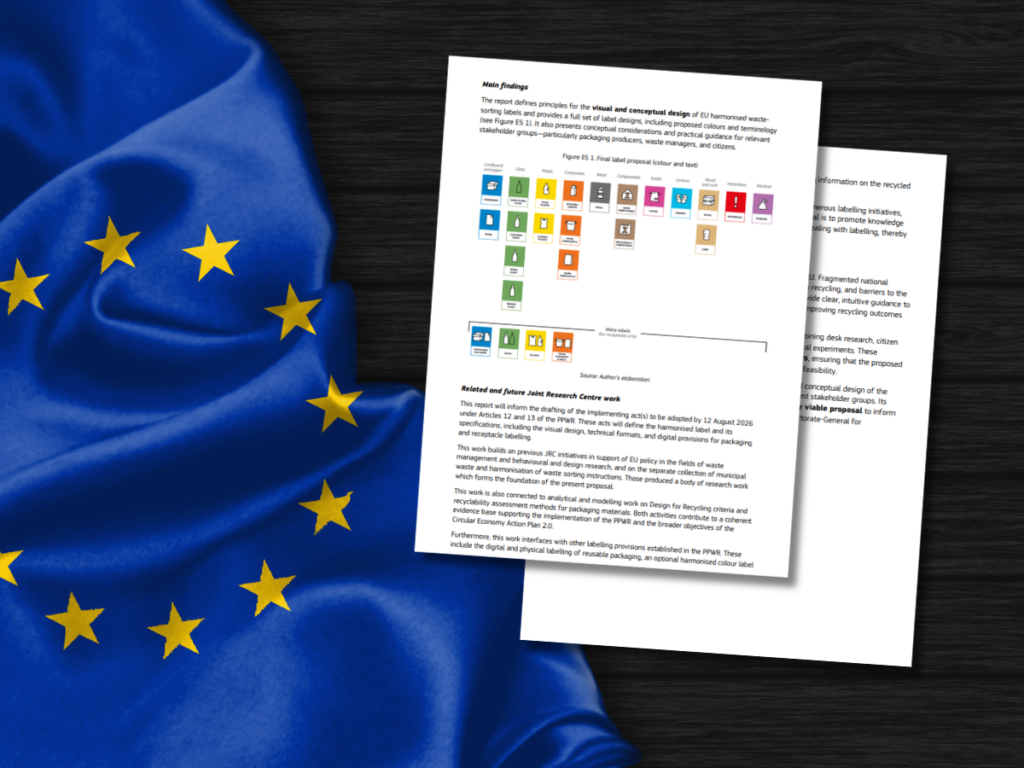
Source (screenshots): Joint Research Center
The Broader Secondary Legislation Picture
The labelling delay is symptomatic of a wider challenge facing the PPWR’s implementation. The regulation relies heavily on secondary legislation to operationalize its core requirements. Several of the most commercially significant implementing and delegated acts, covering recycled content calculation methodology, recyclability assessment criteria, sustainability criteria for recycling technologies and the labelling system, are either pending or overdue.
For packaging producers, the practical consequence is a period where the primary obligations of the PPWR are legally binding but the detailed rules on how to demonstrate compliance are still emerging. The Declaration of Conformity, technical documentation and substance requirements under Articles 5 and 15 apply from 12 August 2026 regardless of the status of secondary legislation. But the more visible, consumer-facing requirements depend on acts that have not yet been adopted.
The Stock Exemption
One practical provision that producers should be aware of is Article 12(12). Packaging manufactured in the EU or imported before the labelling requirements enter into force may continue to be placed on the market for three years after the labelling deadline. This means that existing stock does not need to be destroyed, relabelled or withdrawn. The three-year window applies from the effective labelling date, not from the date the implementing act is adopted.
Conclusion
The Commission’s failure to meet its own deadline for the PPWR labelling implementing act does not alter the underlying obligations. Producers should not interpret the delay as a relaxation of the timeline. Once adopted, the 24-month implementation window will apply without extension. The most practical step for now is to ensure that the other PPWR obligations are being met, track the expected Q4 2026 publication and avoid investing in label changes until the final specifications are published.