On 7 August 2026, the Italian government adopted Decreto-Legge n. 143, introducing mandatory compostability requirements for specific categories of single-use plastic packaging. The decree entered into force the following day, four days before the PPWR became generally applicable on 12 August 2026.
TABLE OF CONTENTS
The measure uses the flexibility provision under Article 9(2)(b) of the PPWR, which allows Member States to replace the standard recyclability requirements with compostability requirements for certain packaging formats, provided the country has effective biowaste collection and organic recycling infrastructure in place. Italy is the first Member State to use this provision.
Which Packaging is Affected
The decree amends Italy’s Environmental Code (Codice dell’Ambiente, D.Lgs. 152/2006) by adding a new Article 226-quinquies that applies to four categories of single-use plastic packaging:
- Packaging for pre-packed fresh fruit and vegetables weighing less than 1.5 kg
- Single-use plastic food and beverage packaging used in the hotel, restaurant and catering (HoReCa) sector, filled and intended for on-premises consumption.
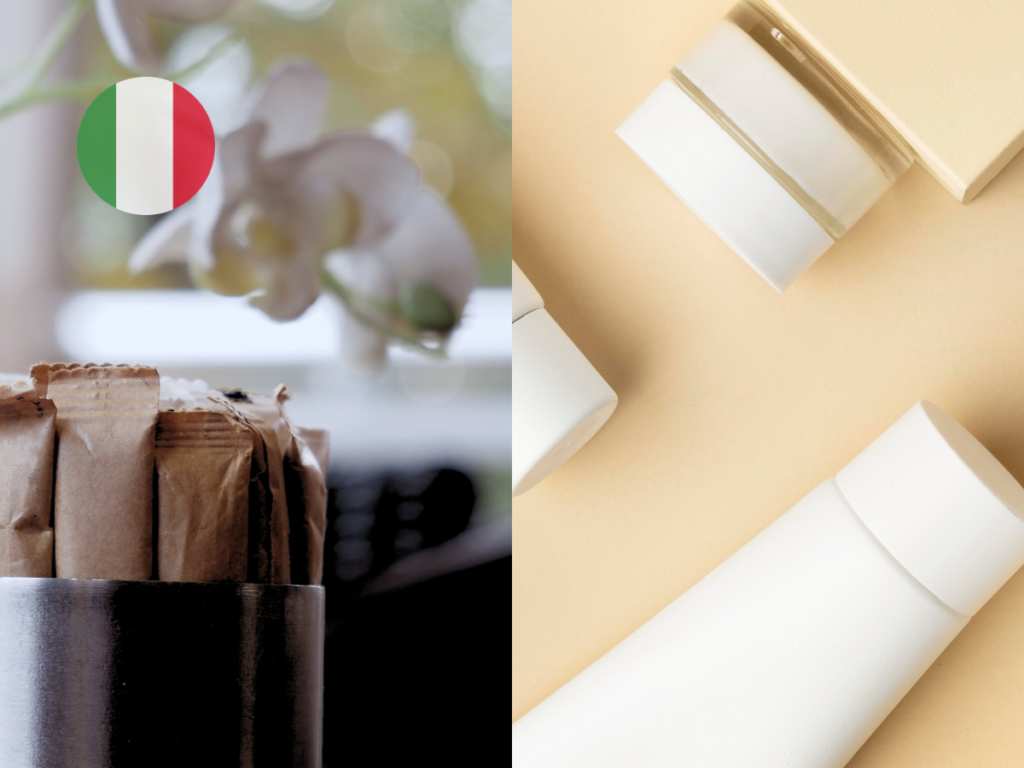
- Single-use plastic packaging in the HoReCa sector containing individual portions of condiments, sauces, coffee creamer and sugar. Two exceptions apply: packaging provided with ready-to-eat takeaway food intended for immediate consumption and packaging required for hygiene and safety in medical care facilities such as hospitals and nursing homes.
- Single-use flexible packaging for cosmetics and hygiene products used in the hospitality sector, intended for a single guest booking and disposed of before the next guest arrives.
All four categories must be certified as biodegradable and compostable by accredited bodies, in conformity with EN 13432 or equivalent European composting standards.
Why Italy Acted Ahead of the 2030 Mandates
Under Article 25 and Annex V of the PPWR, specific single-use plastic packaging formats (such as pre-packed fresh fruits and vegetables under 1.5 kg, single-portion condiment/sauce sachets and miniature hotel amenities) are banned from 1 January 2030. Furthermore, from 2030, all packaging placed on the market must meet standard design-for-recycling requirements.
By passing Decreto-Legge n. 143 prior to PPWR, Italy made early use of the flexibility clause under Article 9(2)(b). This proactive step provides immediate legal certainty for domestic businesses producing and using certified compostable alternatives (EN 13432). Rather than waiting for the 2030 deadline, Italy secured a formal pathway that allows compostability instead of mechanical recyclability, while granting the industry a transition period of over three years before fines take effect in 2030.
While the European Commission raised questions during the TRIS notification process regarding single-market harmonization and cross-border biowaste streams, its observations did not constitute a formal rejection or extend the standstill period, allowing Italy to proceed.
Sanctions and Timeline
The decree is in force from 8 August 2026, but penalties for non-compliance will only apply from 1 January 2030. This gives businesses a transitional period of more than three years to adapt. Fines for violations range from €2,500 to €25,000 and can be increased up to four times the maximum if the value of the non-compliant packaging exceeds 10 % of the offender’s turnover.
The decree explicitly states that the compostability requirement does not override food contact material obligations under Regulation (EC) 1935/2004, Regulation (EU) 10/2011 and Regulation (EC) 2023/2006. Compostable packaging intended for food contact must still comply with all applicable food safety requirements.
Implications for the Packaging Sector
Italy’s decree has significance beyond its national borders. As the first Member State to exercise the Article 9(2)(b) flexibility, it sets a precedent that other countries with developed biowaste infrastructure may follow. The decision effectively creates a parallel compliance pathway within the PPWR: compostability instead of recyclability, for specific packaging formats and under specific conditions.
For producers placing packaging on the Italian market, the immediate question is whether their current packaging falls into one of the four affected categories. If so, they will need to source EN 13432-certified compostable alternatives or ensure their existing products meet the standard. The three-year penalty grace period provides time, but the legal obligation is already in force.
For exporters selling into Italy, particularly in the fresh produce and HoReCa supply chains, the decree adds a market-specific requirement that does not apply elsewhere in the EU. A packaging format that is perfectly compliant under the PPWR’s recyclability rules may not be sufficient for the Italian market if it falls within the scope of the decree and is not compostable.