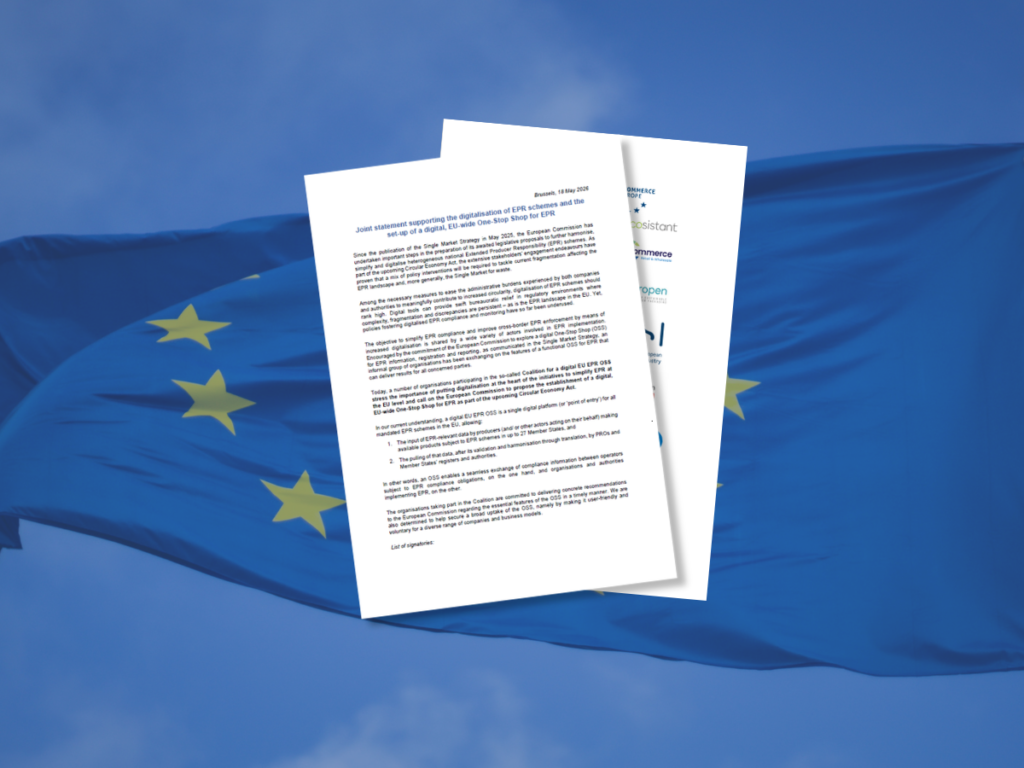
A coalition of European industry associations has published a joint statement calling on the European Commission to introduce a digital, EU-wide One-Stop Shop (OSS) for Extended Producer Responsibility as part of the upcoming Circular Economy Act. The statement, co-signed by organisations including Europen, EuroCommerce, EURATEX and Ecommerce Europe, reflects growing frustration with the administrative complexity created by fragmented national EPR systems across the EU.
TABLE OF CONTENTS
The Problem: 108 Parallel Compliance Processes
The core argument in the joint statement is straightforward. Companies active in multiple EU member states and subject to EPR obligations across packaging, electronics, batteries and textiles can currently face up to 108 separate compliance processes, each with its own registration requirements, reporting formats, deadlines and national registry. This represents a real and measurable cost for producers, particularly those operating cross-border e-commerce or selling into multiple markets.
The statement advocates for online marketplaces to be able to submit EPR-relevant information directly to national registries on behalf of producers, a shift that would reduce duplication and improve the accuracy of compliance data held by authorities.
What the One-Stop Shop Would Do
The proposed OSS is envisioned as a single digital platform through which producers (or organisations acting on their behalf) could input all EPR-relevant data once, with that data then being validated, translated and made accessible to producer responsibility organisations (PROs), national registries and enforcement authorities across member states.
The key features outlined in the joint statement include a centralised interface for single registration, reporting and eventually fee payment across all applicable EPR schemes, integration with national registries through standardised application programming interfaces (APIs) and a design that accommodates a diverse range of business models and company sizes. The signatories are explicit that the OSS should be voluntary and user-friendly, a tool that reduces administrative overhead rather than adding another layer of compliance obligation.
The Commission’s own Single Market Strategy, published in May 2025 , committed to exploring a digital OSS for EPR information, registration and reporting. The joint statement acknowledges this commitment but argues that digitalisation has so far been underused in EPR policy and should be placed at the centre of the Circular Economy Act rather than treated as a secondary consideration.
The PPWR Context
The timing of the joint statement is significant. The Packaging and Packaging Waste Regulation (PPWR) begins to apply from 12 August 2026. Among its requirements is the introduction of national producer registers and EPR fee modulation based on recyclability performance grades. Without a harmonized digital infrastructure, the risk is that these new requirements simply add another layer to an already fragmented system, with each member state implementing its own register in its own way.
The Circular Economy Act, expected later in 2026, represents the next legislative opportunity to address this issue at source. The joint statement is timed to influence the Commission’s drafting priorities before the proposal is finalized.
Conclusion
The case for a digital EU EPR One-Stop Shop is well-established and the industry coalition behind this statement is broad enough to carry weight in the Commission’s deliberations. The question is whether the Circular Economy Act will treat digitalization as a structural priority or as an optional add-on. For packaging producers and importers already navigating multiple national EPR registries, the answer to that question will have direct operational impact from 2026 onwards.