The 12th of August 2026 has long been marked in red on the calendars of packaging professionals across Europe. It is the date on which most provisions of the Packaging and Packaging Waste Regulation (PPWR) become legally binding across all EU member states. But with that deadline now just three months away, a significant portion of the industry has taken the unusual step of formally requesting a postponement from the European Commission.
TABLE OF CONTENTS
The Request and the Reasons Behind It
In late April 2026, a coalition of major food, beverage and consumer goods companies sent a letter to EU institutions calling for the enforcement of a specific PPWR provision to be delayed. The provision in question is Article 5(5), the one that bans the use of PFAS above a defined concentration threshold in food-contact packaging.
The core argument is not that companies oppose the restriction. Most accept that PFAS have no place in food packaging. The problem is that several critical technical questions have not yet been answered, making compliance genuinely difficult to verify.
The two main points are:
- The regulation distinguishes between intentionally and unintentionally added PFAS, but no agreed methodology exists for making that distinction in practice. Without a standardized testing and assessment approach, companies cannot be certain whether their materials comply or not.
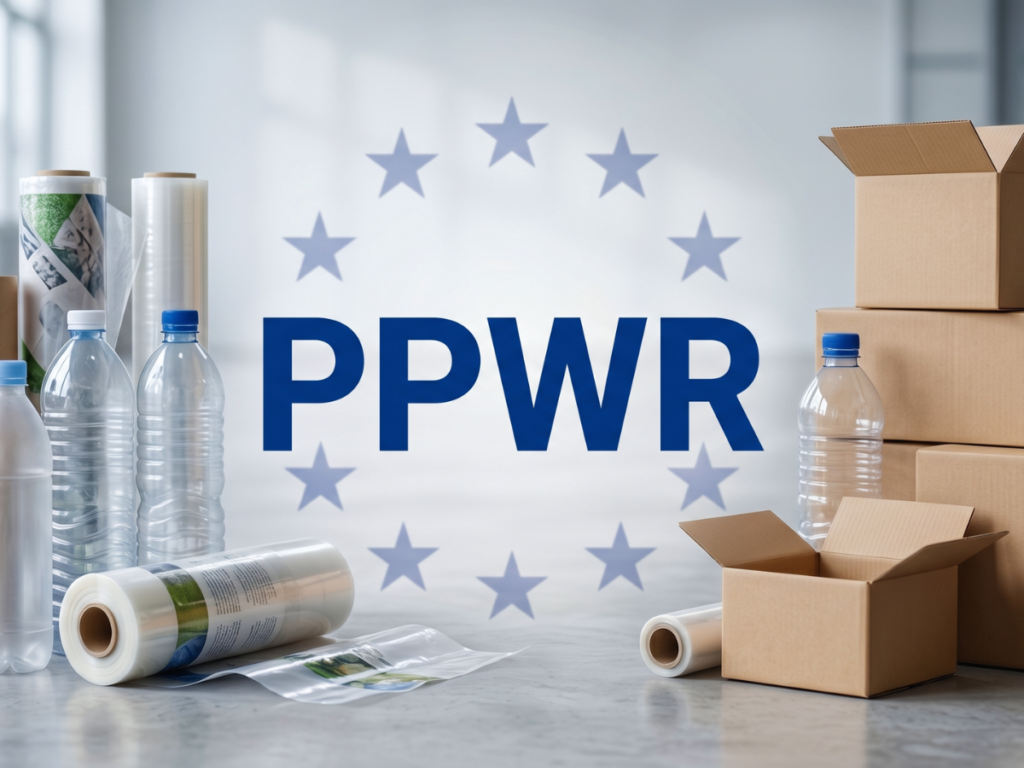
- Annex V of the PPWR restricts certain single-use plastic formats, but it remains unclear whether this restriction covers plastic shrink wrap used on multipacks. The Commission has committed to clarifying this, but not until February 2027. That leaves companies with less than 18 months to redesign and re-equip their packaging lines if the answer requires changes.
The signatories argue that without legal certainty on these points, uniform enforcement across the EU is impossible and the business costs of acting on incomplete information are significant.
A Sector Divided
The request has not been met with unanimous support from within the industry. While the letter attracted signatures from a broad range of major players across the food and beverage value chain, many other companies chose not to sign, an indication that the sector is not speaking with one voice on this issue.
Some professionals see the request as a legitimate and constructive response to a real implementation problem. When companies of this scale raise compliance concerns collectively, the argument goes, it is worth taking seriously. The PPWR is one of the most complex pieces of packaging legislation ever introduced in the EU, touching packaging design, materials, recyclability, labelling, chemical content, reuse systems and supply chain data. Getting it wrong has consequences in both directions: for companies that invest in changes that turn out not to be required and for those that fail to act and face enforcement.
Others are more sceptical. As we have previously covered, the Commission has already published guidance documents and a detailed FAQ in March 2026 to support businesses navigating the new requirements. From this perspective, the petition risks being read as a delay tactic by companies that have had years to prepare, since the PPWR was formally adopted in December 2024 and entered into force in February 2025.
Environmental Opposition
Environmental organisations have responded firmly against any postponement. Their position is that the PPWR is the result of years of democratic legislative process and that adjusting its deadlines under industry pressure undermines the integrity of EU law. They also point to the environmental cost of delay. Every month that the regulation is not enforced, is a month in which non-compliant packaging continues to reach the market.
Political Dimensions
The pressure is not coming from industry alone. Germany has previously pushed for the PPWR’s start date to be moved to early 2027. As of now, the Commission has not confirmed any change to the schedule and companies should continue preparing on the assumption that August 2026 remains the operative date.
What Businesses Should Do
The petition does not change the current legal position. The PPWR applies from 12 August 2026 and the obligations it introduces. PFAS restrictions, recyclability requirements, labelling rules, minimisation obligations and EPR frameworks remain in force unless and until the Commission announces otherwise.
For packaging professionals, the practical advice is straightforward: continue compliance preparations, monitor Commission communications closely for any update on the contested provisions and document the steps being taken to achieve compliance. Even if a targeted postponement is granted on specific articles, it will not affect the regulation as a whole.
Conclusion
The CEO petition is the most visible sign yet that the gap between PPWR’s legislative ambition and industry’s operational readiness is real. Whether or not the Commission grants a delay, the underlying message is the same: the regulation is not going away, the technical questions need answers and the time available to act is short.